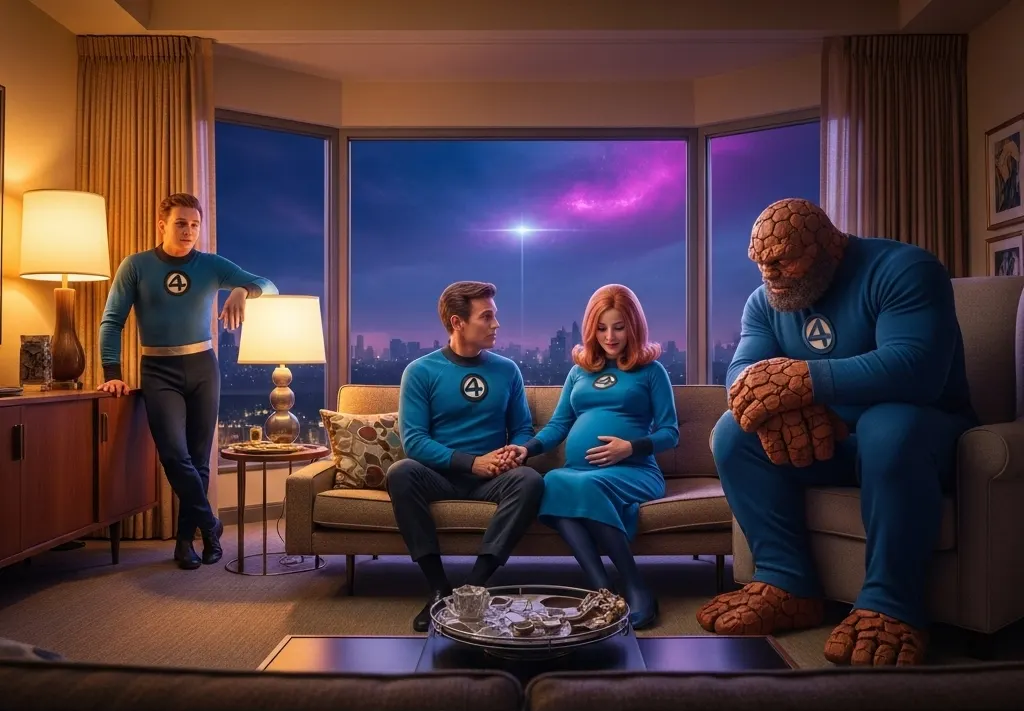
MCU Integration: Phase Six Launch and Multiverse Expansion
The Fantastic Four: First Steps marks a pivotal moment as the 37th entry in the Marvel Cinematic Universe and the official launch of Phase Six. Set in Earth-828, this alternate universe allows Marvel Studios creative freedom while expanding the MCU’s multiverse narrative. The film directly connects to future tentpole releases including Avengers: Doomsday (2026) and Avengers: Secret Wars (2027), where the cast will appear alongside Robert Downey Jr. as Doctor Doom.
Unlike previous MCU entries bogged down by multiverse complexity, this standalone experience requires minimal prerequisite viewing, making it accessible to both newcomers and longtime fans. The strategic positioning as Phase Six’s foundation demonstrates Marvel’s commitment to reinventing their narrative approach post-Endgame.
Plot Overview: Galactus Threat and Family at the Core
Set in 1964, four years after gaining their cosmic radiation powers, the Fantastic Four are already established as Earth’s celebrated protectors. The story centers on Reed and Sue’s pregnancy announcement, adding intimate stakes to their superhero duties. When the Silver Surfer (Shalla-Bal) arrives as herald to the planet-devouring Galactus, the cosmic entity specifically targets their newborn son Franklin for his latent superpowers.
This narrative choice shifts focus from traditional origin storytelling to established character dynamics. The plot culminates in Subterranea battles led by the Mole Man, balancing cosmic threats with underground conflicts. By avoiding the origin story trap that plagued previous adaptations, the film delivers a straightforward, character-driven experience.
Main Cast and Character Highlights
Pedro Pascal leads as Reed Richards/Mister Fantastic, bringing intellectual depth and emotional warmth to the stretchy genius.
Vanessa Kirby’s Sue Storm/Invisible Woman delivers compelling dramatic weight, particularly during her space childbirth sequence.
Joseph Quinn’s Johnny Storm/Human Torch provides charismatic banter.
Ebon Moss-Bachrach’s Ben Grimm/The Thing showcases expressive CGI work that improves significantly over past iterations.
Julia Garner’s casting as Shalla-Bal represents a gender-swapped take on the traditionally male Silver Surfer character, sparking both praise and controversy among fans.
Ralph Ineson voices Galactus as a terrifying cosmic force, though critics note the character’s somewhat simplistic motivations.
Supporting performances include Paul Walter Hauser as Mole Man and Natasha Lyonne in a new scientist role.
Retro-Futuristic 1960s Setting and Visual Design
Earth-828’s vibrant 1960s-inspired world blends mid-century aesthetics with sci-fi elements like the Fantasticar and H.E.R.B.I.E. robot butler. Production designer Kasra Farahani creates a distinctive visual palette that references Pan Am airline glamour and Jetsons-style technology. The Baxter Building serves as the team’s headquarters within this retrofuturistic landscape.
Director Matt Shakman prioritized practical effects over heavy CGI reliance, creating tangible environments that feel authentic for both performers and audiences. This design philosophy extends to costume work and set pieces, distinguishing the film from other MCU entries through its unique temporal aesthetic.
Director Matt Shakman’s Vision and Approach
Shakman brings extensive television experience from WandaVision and It’s Always Sunny in Philadelphia to his first major studio film. His familiarity with Kevin Feige from WandaVision influenced his selection for this project. Drawing inspiration from Jonathan Hickman’s comic run, Shakman emphasizes family dynamics over spectacle.
The director’s unconventional approach included casting Pedro Pascal, Vanessa Kirby, Joseph Quinn, and Ebon Moss-Bachrach without traditional auditions, believing they naturally embodied their characters. Shakman’s television background informed his collaborative style and character-focused storytelling, prioritizing emotional resonance over pure action sequences.
Box Office Performance and 2025 Superhero Market Context
Fantastic Four Sets the Stage for 2025’s Biggest MCU Hit
The Fantastic Four: First Steps dominated 2025’s preview earnings with $24.4 million, establishing itself as the year’s most anticipated release. Global opening weekend projections range from $190-210 million, with domestic expectations of $100-110 million and international forecasts of $90-100 million. These figures position the film to potentially surpass Captain America: Brave New World’s $413 million worldwide total, making it 2025’s highest-grossing MCU entry.
Fantastic Four Stakes Its Claim in 2025’s Superhero Showdown
Within the competitive 2025 superhero landscape, the film faces direct comparison with DC’s Superman reboot, which launched earlier in the year to strong critical and commercial reception. While Superman established the benchmark for superhero quality in 2025, Fantastic Four’s unique retrofuturistic approach and MCU integration provide distinct market advantages. The film’s production budget exceeded $200 million, with an additional $100 million allocated for global marketing campaigns, reflecting Marvel Studios’ confidence in the property as a franchise cornerstone.
The Multiverse Bet: Marvel’s High-Stakes Setup for Phase Six
The financial stakes extend beyond immediate returns, as strong performance validates Marvel’s post-Endgame multiverse strategy and directly influences confidence levels for the upcoming Avengers: Doomsday and Secret Wars crossover events. Success here proves crucial for Phase Six momentum and the broader integration of former Fox properties into MCU continuity.
Critical Reception and Fan Response Analysis
Marvel’s Strongest in Years, But Still Outshined by Superman (2025)
The film achieved an 89% “Certified Fresh” rating on Rotten Tomatoes, with critics praising the cast chemistry, retro aesthetic, and emotional core while positioning it as Marvel’s strongest recent output. However, professional reviews note it doesn’t quite match the critical acclaim of DC’s competing Superman (2025). Critics particularly appreciate the sincere, earnest tone that contrasts sharply with recent MCU entries heavy on snark and humor.
Positive Reception Balances Praise for Simplicity with Calls for More Depth
Audience reception mirrors critical praise, with fans emphasizing appreciation for the minimal prerequisite viewing requirements and genuine family-focused themes. Some viewers express concerns about insufficient action sequences and narrative depth compared to other superhero blockbusters, though the overall response indicates successful character reintroduction after previous Fox adaptation failures.
Fan Buzz Around MCU’s Fantastic Four: Casting, Setting, and Multiverse Speculation
Social media engagement on X (formerly Twitter) reveals enthusiastic discussions centered on MCU integration speculation, particularly regarding multiverse connections and future Avengers appearances. Character portrayal conversations dominate fan discourse, with Pedro Pascal’s Reed Richards interpretation and Julia Garner’s controversial gender-swapped Silver Surfer generating the most debate. The unique 1960s retrofuturistic setting produces significant visual appreciation posts, with fans sharing production design details and aesthetic elements. Plot discussions focus heavily on the established four-year superhero timeline, differentiating this adaptation from origin-heavy predecessors, with comparison threads generally favoring the new approach over 2005 and 2015 versions.
Reboot vs Remake Classification
The Fantastic Four: First Steps functions as a reboot rather than direct remake, introducing characters fresh within MCU continuity rather than retelling previous film plots. This second reboot of the film series creates new narrative possibilities while honoring comic source material. The Earth-828 setting allows creative freedom without main MCU timeline constraints.
Unlike remakes that recreate specific previous stories, this reboot establishes original character dynamics and plot structures. The distinction proves important for fan expectations and franchise positioning, separating this version from Fox’s 2005 and 2015 attempts while building toward future MCU integration.
Did You Know? Trivia and Behind-the-Scenes Details
- The film includes tribute cameos to the unreleased 1994 Fantastic Four film, with Alex Hyde-White appearing as a newscaster
- Michael Giacchino’s score receives praise as one of his strongest MCU compositions, enhancing the retro-futuristic atmosphere
- Matt Shakman left a planned Star Trek film to direct this project, choosing family themes over space exploration
- John Malkovich’s casting resulted from his previous collaboration with Shakman on Cut Bank (2014)
- Promotional poster artwork faced criticism for possible AI usage, which Marvel Studios denied
- The film’s release date shifted three times (November 2024, February 2025, May 2025) before settling on July 25, 2025
- H.E.R.B.I.E. the robot butler represents a deep comic book reference that longtime fans appreciate
- The movie draws specifically from The Galactus Trilogy (Fantastic Four 48-50, 1965-1966) for core plot elements